
Keith S. Delaplane
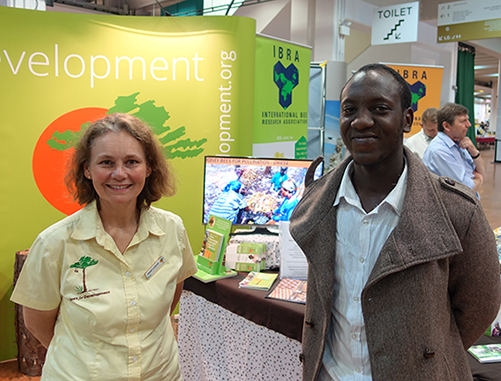
 Keith is Professor Emeritus of Entomology at the University of Georgia where he worked from 1990-2024. Research by Keith, his students, and coworkers resulted in hundreds of publications ranging across basic honey bee (and termite) biology, health management, pollination, and social evolution, garnering over 6500 citations by peers around the world. He is author of the books Crop Pollination by Bees (2000); its second edition published in two volumes (2021 and 2023); and First Lessons in Beekeeping (2007; new edition due out this year). His latest book, Honey Bee Social Evolution was published by Johns Hopkins University Press in 2024. In 2014 he was inducted into the Most Excellent Order of the British Empire as an honorary member for his honey bee research and education efforts throughout the UK. Keith and his wife Sonja live in Athens, Georgia where they keep a few bee hives in their back yard.
Evolving the honey bee superorganism and what it means for beekeepers
09:30 Thursday 22nd October Gold Cup Suite
This is an overview of the principles of social evolution, the superorganism concept, and how beekeepers routinely experience traces of this history. The honey bee models one of the least appreciated aspects of biology – that evolution operates at multiple levels. Evolution is usually taught and understood at the individual level. This is the classical “survival of the fittest” model that rewards reproduction to selfish individuals out-competing other individuals to pass along their successful genes in the breeding population. Evolution at the group level extends these rewards to those groups that outcompete other groups in the breeding population. Even though competition between groups may be selfish, keen, or even vicious, it’s very different within the group where evolution rewards social traits such as altruism, cooperation, and conflict resolution. This tacit “agreement” to suspend one’s individual reproductive interests is essential to the formation of any cohesive group and has happened many times among life’s great transitions including chromosomes bundling into a single cell, single cells bundling into a multicellular organism, and organisms bundling into a superorganism. Honey bees model this last great transition and, quite possibly, so do human beings.
Multiple-mating in the honey bee and what it means for bee breeding
09:30 Friday 23rd October Gold Cup Suite
The honey bee queen mates with multiple males, and their stored sperm makes up the paternity of her worker offspring for the rest of her life. The colony is therefore a mixture of numerous worker subfamilies, each sired by a different drone. This multiple-mating behaviour is called polyandry, and it’s an important source of genetic variation for promoting group level fitness.
Studies have documented at least 20 colony level traits that improve in tandem with increasing queen mating number. These discoveries force us to rethink the role of polyandry in social evolution and, more immediately, in honey bee breeding. Being developed under the influence of traditional animal breeding schemes, bee breeding has historically treated polyandry as a problem to be solved as if the queen’s uncontrolled multiple out-matings dilute the breeder’s efforts to augment specific traits. This lecture will critique this viewpoint by foregrounding genetic variation over genetic specialisation as the driving strategy honey bees have used to marshal genetics for solving problems and suggest how polyandry can be incorporated into traditional trait-based selection schemes.
Partnering with biology to improve honey bee health
14:45 Saturday 24th October Gold Cup Suite
This lecture continues the focus on group-level selection with an overview of colony traits that are adaptive for long-term health and survival and offers points of interface with practical beekeeping. The lecture does this under the rubric of “Darwinian beekeeping,” emphasising the concept of effect size, focusing on evidence-based science, and pointing out limits and misunderstandings in the application of Darwinian beekeeping. At least three broad camps of knowledge will be discussed: epidemiology, nest architecture, and genetics and breeding, all with the aim of focusing beekeepers on the most promising and effective ways of partnering with biology to improve bee health.
M. Alice Pinto
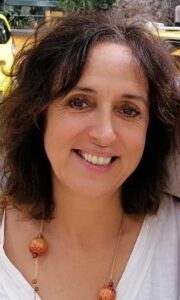 M. Alice Pinto is a Professor at the Bragança Polytechnic University and a researcher at the Mountain Research Centre in Portugal.She earned her PhD in Entomology from Texas A&M University, USA, where she developed a lasting interest in honeybees while studying the genetics of a feral population undergoing Africanization. Today, her main research interests are on the introgression and genetic integrity of honeybee subspecies across their native range, how these subspecies adapt to local environments, and how their genetic diversity can be protected. She has worked on numerous national and international research projects on honeybee genetics, health, and conservation. She has contributed to the development of innovative tools, including molecular panels for assessing genetic introgression, as well as DeepWings, a popular software for identifying honeybee subspecies from wing images. She has published widely in scientific journals and beekeeping magazines and works closely with scientists and beekeepers to promote the conservation of local honey bee populations.
First talk: From Morphology to Genes: The Nuts and Bolts of Honey Bee Identification
14:00 Friday 23rd October Gold Cup Suite
How can we tell which subspecies a given honey bee belongs to? This talk explores the different approaches used to identify honey bee subspecies, from traditional morphology to modern genomic tools. It examines Ruttner’s morphological traits and the use of wing shape and venation as markers of subspecies identity, before moving from phenotype to genotype and introducing single-nucleotide polymorphisms (SNPs) as tools to assess subspecies identity, ancestry and admixture. The strengths and limitations of these different approaches are discussed, highlighting why subspecies identification is not always straightforward, particularly when gene flow, admixture and selective breeding can create a mismatch between a bee’s appearance and its genomic ancestry.
Second Talk: From Genes to Gene Pools: The Processes That Shape Honey Bee Diversity
09:15 Saturday 24th October Gold Cup Suite
Honey bee genetic diversity is shaped by evolutionary forces that act at different scales and can either generate or erode variation. This talk examines howgene flow, mutation, recombination and introduce or reshuffle genetic variation, while genetic drift, inbreeding and natural selection can reduce diversity or alter its distribution across the genome. It illustrates how these processes shape diversity within and among honey bee populations, from isolated island populations to natural hybridisation and the human-mediated movement of colonies and queens. Understanding these forces is essential for interpreting genetic patterns and informing honey bee conservation and management.
Third talk: The genetic footprint of modern beekeeping
13:15 Saturday 24th October Gold Cup Suite
For thousands of years, honey bee populations evolved in relative isolation, giving rise to the approximately 30 subspecies of Apis mellifera recognised today. However, modern beekeeping has dramatically increased the movement of honey bees through queen trade, commercial breeding, and migratory beekeeping, creating unprecedented opportunities for interbreeding between historically distinct populations and, in some cases, for the replacement of native gene pools. This raises an important question: are honey bee subspecies still genetically distinct, or has modern beekeeping reshaped their genetic identity? In this talk, I will present the results of a large-scale study based on nuclear DNA, mitochondrial DNA, and wing morphometrics from more than 1,500 colonies sampled across Europe. All three approaches told the same story: C-lineage bees (A. m. carnica and A. m. ligustica) now dominate much of Europe, including regions where the M-lineage dark bee (Apis mellifera mellifera) once thrived. We also detected evidence of extensive introgression on several Mediterranean islands. These findings demonstrate how profoundly modern beekeeping has reshaped honey bee populations and highlight the need to balance genetic improvement and queen trade with the conservation of locally adapted bees, which represent an invaluable resource for the long-term sustainability and resilience of beekeeping.
Eoghan Mac Giolla Coda
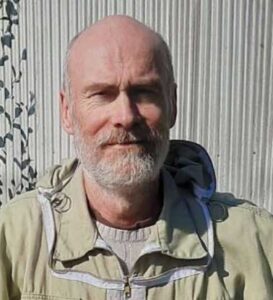 Eoghan Mac Giolla Coda is a commercial beekeeper based on Ireland’s east coast. As a
fourth-generation beekeeper, he learned his craft through helping his father with the famous Galtee black bees of Co. Tipperary. After settling in Co. Louth, he embarked on his own beekeeping enterprise using local strains of native Irish honey bee. He is Education Officer for Co. Louth Beekeep-ers’ Association, helping organise classes for beginners and improvers and lecture programmes for all membes.He also lectures to other beekeeping associations around Ireland. He is involved with Co. Louth BKA’s native honey bee breeding programme and the maintenance of Co. Louth as a conservation area for the black bee. He serves on the national committee of the Native Irish Honey Bee Society, until recently serving as editor of The Four Seasons, the voice of the Irish black bee movement. Eoghan currently manages over 150 col-onies and rears native queens for his own use and that of local beekeepers. He has won the World Class competition at the London Honey Show in 2014 and 2015 with the famous bell heather honey of the Cooley Mountains of North Louth.
Commercial Beekeeping Under Difficult Conditions
11:00 Thursday 22nd October, Gold Cup Suite
Climatic conditions mean that beekeeping can be difficult on the northwestern margins of Europe. Although the Gulf Stream ensures that winters are generally mild, summer conditions are often cool and damp. The European dark bee, Apis mellifera mellifera, has evolved to cope with these conditions. Due to its conservative brood-rearing nature, the native Irish honey bee is able to respond rapidly to unpredictable and intermittent honey flows and is thrifty with regard to stored honey. Other characteristics of the native bee that play key roles in honey production are flying behaviour, temperament, longevity, swarming, disease resistance and over-wintering. To optimise honey production, it is important for the beekeeper to consider such management factors as swarm prevention and control, bee health, hive records, colony evaluation and breeding.
Some Useful Tips and Tricks
11:00 Friday 23rd October, Gold Cup Suite
Paul Verrier
 I have been a beekeeper since 1982 with a maximum of 17 hives in the early days.
I became interested in honeybees in my early years at Rothamsted where I started in 1975 as a scientific trainer for the new-fangled computers that were beginning to re-shape scientific processes, and with the entomologists, I became fascinated by the tales of the recently discovered queen bee pheromones. Later, after I inherited a WBC hive, I took up the challenge of trying to persuade bees to do what I wanted. In general I lost. However, I continued at Rothamsted and gained my own research group and eventually became a mainline bioinformatician working on DNA, RNA and genetic pathways. When I formally retired, I remained as a visiting scientist until a few years ago, working with the Rothamsted Insect Survey on the analysis and storage of their vast collection of data. I now mainline on beekeeping science.
Honeybee pheromones
12:30 Thursday 22nd October Gold Cup Suite
The majority of insects have a good sense of smell. The social insects have learnt, or have evolved, to use their sense of smell in amazing ways. Why? What might the pressures be to make this happen? The honeybee probably has the most advanced smell oriented society. In this talk I will discuss why smell became important and will demonstrate how good the honey bee snozzle is, what some of the smells are like to us, where these smells come from, and how these smells are used to control the behaviour of the colony in and out of the hive. Over the years since the first discovery of the queen pheromone in the late 1960’s that not only does the queen have smells that attract members of the colony, but the larva also gives off odours that alter the behaviour of the workers and workers move the queens smell about. What about the workers and the much maligned drones? Recent discussions about the varroa tolerant ‘hygienic colony’ are indicating honeybees maybe becoming sensitive to the smell of varroa inside a capped cell – or maybe the smell of a damaged pupa inside the cell. Bee smells are fascinating and are not all known!
Paul Boyle
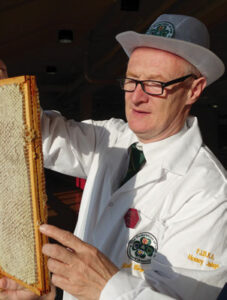 Paul started beekeeping and also competing in honey shows in 2007, with his local beekeeping club Co Louth Beekeepers. He is an Irish Beemaster (Master Beekeeper) and his exhibiting Honey and hive products ignited in him an interest in Honey Judging, he is a qualified Honey Judge in Ireland, England and Scotland and also Judges for Apimondia and travels extensively in this role both judging and lecturing. He is a Director of FIBKA the Irish beekeeping organisation and has held various roles in FIBKA over the years. As chairperson of his county club he enjoys teaching all aspect`s of beekeeping beginners, especially preparing and showing honey. While not beekeeping Paul works as a theatre nurse in his local hospital.
Getting the bees ready, their stay on the mountain and preparing their rewards for showing.
14:30 Thursday 22nd October Gold Cup Suite
This talk is a walk through the bell heather covered Cooley Mountains in the North East of Ireland. A delight of sensory perception, with the sound and vision and most important the aroma of the bell heather in full bloom that ends up wafting out of the hives and ultimately onto the show bench. The talk will cover preparing the bees for their annual excursion to the heather moor above the treeline. Their management when there and weather permitting the harvesting of their precious crop and the preparation of small batch honey for showing at “The National”.
Tony Jefferson
 I’m a 3rd generation beekeeper, based in N.E. England with apiaries around the Whitby area, my beekeeping is based on breeding locally adapted bees with 50 weeks of effort aimed towards 2 weeks of good weather in August to obtain highly prized heather honey. Any Spring and Summer honey gained is a bonus. Those who recall my late father (Allan) will realise how and why, my involvement as a beekeeper commenced as a youngster when I got my first pair of wellies. After 60 years I still follow my father’s advice, with my nephew Richard we operate around 80 colonies. I don’t use queen excluders and operate on a brood and a half principle.
Exhibiting honey has always been a Jefferson passion, I strongly believe it is the best way of promoting the quality of your honey produced. As a qualified honey judge I find it is a great way to give something back and hopefully encourage others to push themselves to exhibit quality items.
Producing bees for maximum heather honey
14:30 Thursday 22nd October Gold Cup Suite
Ling heather honey is quite correctly widely recognised as a premium product, involving challenges to process, but with a bit of targeted intervention at the right time, increased crops can be gained. The notes on this presentation are repeated in the BBKA Advanced Husbandry Publication. Some of the equipment is explained as video clips on the BBKA learning portal.
In the early 1970’s we were one of the first in the UK to obtain a full frame heather honey loosener, imported direct from Norway, which was a significant game changer.
I often find myself repeating one of Father’s well known sayings: “we are not taking them to the moors for a holiday”. Simply this means: having the right bees, the right hive set up, at the right time, is the key to obtaining good surplus. After the heather honey is removed, which is likely into September, then setting bees up for the winter modifies the usual advised practices.
The presentation will be a simple step through of the processes and timings involved to produce increased crops of high quality heather honey, Including simple equipment and its evolution. Also, a simple explanation of how to exhibit the honey to show off its unique qualities.
Paul Honigmann
 Paul has a background in Physics and Engineering, and has been keeping bees for 16 years in Warré and Top Bar Hives in central England, Treatment Free since 2012. He co-ordinates the Oxfordshire Natural Beekeeping Group. His book The Observant Beekeeper is a structured, comprehensive manual for low-intervention beekeeping, covering not only forgotten techniques like inspecting hives without opening them, interpreting bee behaviours, and setting up and using alternative hive types; but also modern knowledge on bee diseases; genetics; swarms; and hive autopsies.
Lessons from Alternative Beekeeping
16:00 Friday 23rd October Gold Cup Suite
A review of unorthodox approaches to managing hives, including: “reading” a hive without opening it; creative solutions at scale; and novel perspectives on breeding. What can you adopt or adapt for your own situation?
Steve McGrath
 Steve is the apiary manager of the Westerham Beekeepers’ bee breeding project, which is raising local, varroa resistant bees for club members with the aim of cutting the number of bees brought into the club area from outside and improving the stock across the area. He manages a total of around 80 colonies of locally-adapted, untreated colonies across his own apiaries and the breeding project apiary, as well as raising new queens and colonies. He is also a BIBBA trustee, with responsibility for the bee improvement groups network as well as varroa resistance information.
How Westerham Beekeepers teach beekeepers and propagate and distribute varroa resistant queens
10:45 Saturday 24th October Gold Cup Suite
The Westerham Beekeepers bee breeding project started in 2024 with the aim of raising varroa resistant, local bees for club members and has started providing bees for members from this season. The project should result in fewer bees being bought in from outside as well as improving the stock across the club area. We also want to select for near native genetics. Steve will run through the ups and downs of the project so far, explaining areas such as the focus on varroa resistance, apiary and stock selection, trait criteria, financing, queen rearing methods, the importance of continual data collection, and the makeup of the project team. He’ll also explain how the project is helping to expand and deepen the knowledge of beekeepers across the club, expanding the education the club offers its members well beyond the first year and the basic assessment.
Karl Colyer
 Karl Colyer has kept bees since 2003. As well as building his own hives, he raises his own queens using locally adapted bees that are known to be hardy, gentle and productive.
The Early Years of Practical Bee Improvement
9:30 Saturday 24th October. Owners and Trainers Lounge
A simple summary of the top-level objectives over the first years as the colony increases in size and age and the beekeeper deals with the challenges and opportunities that being a beekeeper presents over that time-frame.
Dylan Gussman
 Dylan Gussman has been keeping bees for 10 years, and currently has 5 colonies at home, starting at the age of 15 as part of his Duke of Edinburgh award. One of the greatest challenges has been keeping bees whilst at university. As a member of the Meon Valley BKA in Hampshire, he co-leads the training team, organising the website and newsletter. Writing regularly for BeeCraft, with particular interests in climate change and beekeeping, threats to honey bees and understanding the behaviour of the superorganism. Part of his hobby is finding Drone Congregation Areas, something that still remains a mystery to this day. He recently finished his Masters in Environmental Monitoring and Assessment at the University of Southampton and aside from beekeeping has begun a new role as a GIS Consultant. Prior to this, he graduated from the University of Exeter, studying BSc Geography with Applied GIS,
with a first-class degree.
Guarding and Defensive Behaviour
Saturday 24th October. 11:15 Owners and Trainers Lounge
Honey bees are remarkable not only for their cooperation in foraging and nest building, but also for their sophisticated strategies of colony defence. At the heart of this is nestmate recognition, a remarkable ability that enables bees to admit allies while repelling intruders.
When a threat arises, the colony can unleash an extraordinary array of defences: from the well-known stings of Apis mellifera to the ingenious and sometimes surprising tactics of Asian honey bees. Finally, the presentation will turn to the practical side of beekeeping, discussing how to manage defensive colonies and outlining effective approaches to handling varying levels of aggressiveness. It will offer insights into both the science of honey bee defence and the art of managing aggressiveness in the apiary.
Lynfa Davies
 Lynfa lives near Aberystwyth in mid Wales and has kept bees for 20 years with her husband, Rob. She is a Master Beekeeper and in 2019 was awarded the National Diploma in Beekeeping.
Lynfa has 30 colonies which she manages for honey production and for the joy of looking after bees! She raises her own queens and uses these to produce nucleus colonies and to replace her own stock. She is also actively involved in training beekeepers at all levels and regularly gives talks and writes articles for the beekeeping press.
Outside of beekeeping, Lynfa works for Mentera providing support and advice for farmers in Wales. She brings her expertise on insects to this work promoting the value of biodiverse ecosystems in a farmed landscape. In addition, Lynfa has written an online training resource called the Healthy Bees Academy which is funded by the Animal and Plant Health Agency.
Pollen – what do bees do with it?
13:15 Saturday 24th October. Owners and Trainers Lounge
Pollen is an important food for bees and in this talk we will explore why it is so important and where they get it from. Not all pollens are equal and we will discuss how we can help our bees get the best nutrition possible and if there are times that we may need to help them out. What are the key times of the beekeeping year that the bees require pollen and what happens if they do not get enough? Join me to discover what the bees are doing with the pollen they gather and the impact this has on the health, strength and productivity of the colony.